
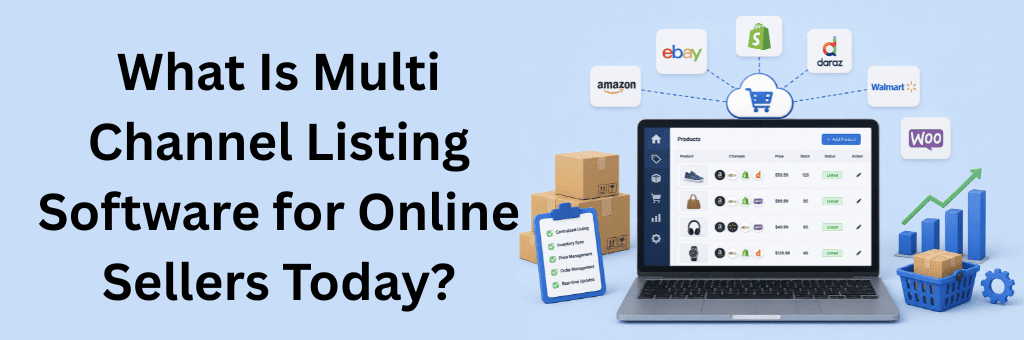
What Is Multi Channel Listing Software is a common question for sellers managing products across several online marketplaces. Multi channel listing software connects listings, prices, stock, orders, and product information. Therefore, sellers can control daily operations from one central dashboard.
Strong multi channel management software also reduces repeated data entry. Meanwhile, ecommerce channel management improves visibility across websites and marketplaces. Growing retailers use multi marketplace management tools for faster expansion.
These systems keep product information consistent across connected sales channels. As a result, online sellers save time and reduce listing errors. They also gain stronger visibility into stock levels and order activity. Moreover, centralized tools help teams launch products faster and maintain reliable marketplace performance.
Online sellers often manage hundreds of products across different marketplaces. Manual updates quickly become slow, confusing, and risky. However, multi channel listing software creates one organized product catalog. Sellers can edit titles, prices, images, descriptions, and categories centrally.
The platform then sends approved changes to every connected channel. Moreover, marketplace listing automation publishes approved product updates across connected sales channels. This process saves time and keeps marketplace listings accurate. Therefore, teams avoid editing each product page separately.
Key benefits include:
Moreover, templates help sellers follow different marketplace requirements. Amazon, Daraz, and Shopify use different listing structures. A connected system adapts product data for each platform.
Reliable multi channel management software connects products, inventory, orders, and reports. Consequently, teams manage daily tasks through fewer systems. Staff can review channel activity without switching between several dashboards.
New orders enter one shared workspace automatically. Efficient cross-channel order processing combines orders from different marketplaces into one workflow. Consequently, teams can review, fulfil, and track every order more easily. Teams can check payments, stock, and shipping progress quickly. As a result, fulfillment becomes faster and more accurate.
Automation also reduces repetitive work. Sellers can schedule price changes, stock updates, and promotional listings. In addition, approval rules protect important product data from accidental changes.
Effective ecommerce channel management gives sellers control over every sales channel. What Is Multi Channel Listing Software becomes especially important when businesses need to connect products, inventory, orders, and marketplace performance in one system. Therefore, managers can identify strong channels and weak listings faster.
Better visibility supports smarter decisions. Sellers can compare sales, fees, returns, and conversion rates. They can then improve prices, promotions, and product availability.
Furthermore, accurate channel data improves customer experiences. Shoppers see correct stock levels and current product details. Clear information builds trust and reduces purchase hesitation.
Growing businesses also need scalable workflows. Manual processes often fail during seasonal peaks. However, centralized operations handle larger volumes with less pressure. This structure supports expansion without rebuilding every daily process.
Multi marketplace management software brings several marketplaces into one connected workflow. Sellers can manage products, stock, orders, and reporting centrally. This approach reduces complexity and supports faster growth.
Major benefits include:
Additionally, one dashboard helps managers compare marketplace performance. They can identify profitable products and rising customer demand. As a result, teams make quicker decisions using clearer performance insights.
Inventory errors can cause overselling, cancellations, and negative reviews. Yet, multi channel management software reduces these risks. It updates stock levels after each confirmed sale.
Strong centralized inventory control keeps stock information consistent across every marketplace. Therefore, sellers can monitor inventory changes from one connected dashboard.
For example, a product may be sold through Shopify. The system then adjusts stock across Amazon and Daraz. Therefore, customers see more accurate inventory information.
Real-time synchronization also supports warehouse planning. Teams can track available, reserved, damaged, and incoming stock. Consequently, sellers avoid confusing physical stock with sellable stock.
Modern multi channel listing software should support Amazon, Daraz, and Shopify integrations. Each platform follows different selling rules. A connected solution helps sellers manage those differences efficiently.
Amazon requires detailed categories and product attributes. Daraz uses local marketplace structures and campaign tools. Shopify gives sellers direct control over branded stores.
A strong platform connects all three environments. It should synchronize prices, stock, orders, and product updates. Therefore, sellers gain one reliable ecommerce view.
API connections can improve speed and accuracy. However, sellers should review integration limits before choosing software. Stable connections protect order flow and inventory visibility.
The right multi marketplace management solution should support present and future needs. Sellers should review integrations, automation, reporting, and scalability.
Important features include:
Moreover, the platform should offer reliable support and secure integrations. Clear dashboards help teams act quickly. Flexible workflows also support future business changes.

Ginkgo Retail connects products, inventory, orders, and marketplace workflows. What Is Multi Channel Listing Software becomes easier to understand through a platform that supports structured ecommerce channel management across digital sales channels. Therefore, teams gain better visibility and stronger control.
The solution helps businesses organize listings from one connected system. It also supports inventory accuracy across marketplaces and online stores. As a result, sellers can reduce overselling and delayed updates.
Ginkgo Retail gives managers clearer performance insights. Teams can review sales activity, product movement, and channel results. Consequently, businesses can plan growth using more reliable information.
Multi channel listing software gives sellers one system for several sales channels. It simplifies product updates, inventory control, orders, and marketplace reporting. Therefore, teams save time and reduce manual errors.
Connected operations also improve customer experiences. Accurate listings and stock levels create stronger buyer confidence. Meanwhile, centralized reports support smarter growth decisions.
Ginkgo Retail gives businesses a unified view of their ecommerce workflows and performance. Ultimately, the right platform supports confident marketplace expansion.
It manages listings, stock, prices, and orders from one dashboard. Therefore, sellers save time and reduce errors.
Ginkgo Retail connects products, inventory, orders, and reports. This structure improves accuracy and daily operational control.
It improves visibility across every sales channel. As a result, businesses scale with fewer operational problems.
Ginkgo Retail centralizes listings, stock, orders, and performance data. Therefore, teams work faster and plan better.
It lets sellers update product information once. The system then shares changes across connected marketplaces.
Ginkgo Retail keeps inventory data connected across marketplaces and stores. Consequently, sellers reduce overselling and cancellations.
Ginkgo Retail improves product visibility, inventory accuracy, and channel reporting. These improvements support stronger online conversions.
Ginkgo Retail suits businesses seeking connected product, inventory, order, and marketplace control from one platform.

CEO & Founder Ginkgo Retail & Comverse | Serial Entrepreneur | Award-Winning SaaS Innovator | E-commerce Veteran | Team Builder | Building AI-driven E-commerce Solutions. He has diverse experience of 10+ years in versatile domains of e-commerce, logistics and tech-oriented business. His eminent role in ecommerce management empowered him to benefit the industry with his knowledge, vision and experience.
Digital Wallet