
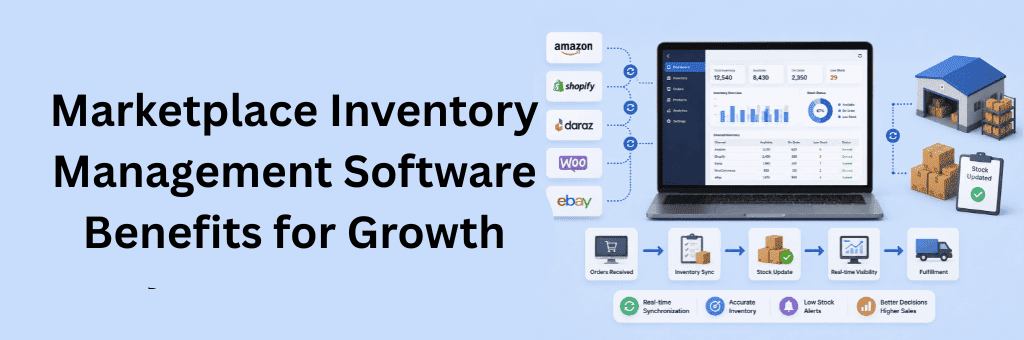
Modern retailers manage inventory across many marketplaces, stores, and digital sales channels. Therefore, accurate stock control has become essential for profitable ecommerce growth. Marketplace inventory management software benefits retailers through centralized visibility, automation, and faster stock updates. A connected marketplace inventory management software platform tracks quantities across every active selling channel. Moreover, ecommerce product management keeps product data accurate across listings and marketplaces. Strong stock synchronization also prevents outdated quantities from reaching shoppers. As a result, businesses reduce overselling, cancellations, and delayed order fulfillment. Modern marketplace inventory systems also improve planning through reliable stock information. In addition, retail automation reduces repetitive manual work across daily operations. These capabilities help teams manage growth without losing inventory accuracy.
What is ecommerce product management for retailers handling multiple online sales channels? It controls product information, listings, pricing, categories, and availability. Therefore, teams maintain consistent information across marketplaces and ecommerce stores. Effective ecommerce product management also supports faster catalog updates and cleaner product data.
Moreover, centralized product control reduces duplicate edits across different selling platforms. Teams can update titles, descriptions, prices, and attributes from one system. Consequently, shoppers receive consistent product information wherever they browse. Strong Ecommerce product management importance also grows as product catalogs become larger.
For example, a retailer may sell through Shopify, Amazon, and regional marketplaces. Manual updates can quickly create inconsistencies. However, connected Ecommerce product management tools simplify daily catalog operations. They also support better multichannel selling without increasing unnecessary manual work.
How marketplace inventory management works depends on centralized inventory data and real-time updates. First, the system receives inventory quantities from warehouses or connected business systems. Next, it calculates available stock for each approved sales channel.
Whenever an order arrives, the system updates inventory automatically. Therefore, connected marketplaces receive revised stock quantities without manual intervention. Returns, cancellations, transfers, and adjustments can also trigger new inventory calculations.
Meanwhile, Multi-channel ecommerce product management keeps products linked across every active marketplace. This connection helps systems match marketplace listings with the correct SKU. Consequently, stock movement remains connected with the correct product record.
Reliable stock synchronization becomes especially important during high sales volumes. A single sale can affect availability across many channels. Therefore, fast updates protect inventory accuracy and reduce customer disappointment.
The biggest Marketplace inventory management software benefits come from control and automation. Retailers gain one reliable inventory view across connected channels. Moreover, centralized visibility helps teams make faster stock and replenishment decisions.
Key advantages include:
Additionally, connected inventory data supports stronger forecasting. Teams can identify fast-moving products and slow inventory earlier. As a result, purchasing decisions become more accurate and timely.
The Best marketplace inventory management software should also support scalable integrations. Flexible systems can connect marketplaces, warehouses, ecommerce platforms, and order workflows. Therefore, retailers can grow without rebuilding inventory operations repeatedly.
How Marketplace inventory management reduces errors starts with fewer manual updates. Manual spreadsheets often contain outdated quantities, duplicate entries, or incorrect SKU mappings. However, automation reduces these common operational mistakes.
For example, marketplace orders can automatically reduce available inventory. Consequently, teams avoid updating each marketplace separately. A centralized system can also validate product and inventory connections.
Moreover, accurate marketplace inventory helps reduce overselling during busy campaigns. Fast stock synchronization sends current quantities across connected sales channels. Therefore, customers see more dependable product availability.
Automated rules can also control safety stock and channel allocation. As a result, retailers can reserve quantities for specific channels. This control supports better availability during promotions and seasonal demand.
Ecommerce product management improves sales by keeping listings accurate and complete. Customers depend on correct descriptions, prices, images, and stock information. Therefore, reliable product data supports better purchase decisions.
Strong ecommerce product management also improves marketplace consistency. Retailers can apply common product standards across multiple channels. Meanwhile, localized details can still support marketplace-specific requirements.
Modern Ecommerce product management tools also reduce catalog maintenance time. Teams can launch new products faster across many selling channels. Consequently, Multi-channel ecommerce product management supports faster expansion.
In addition, accurate product and inventory data improves customer trust. Buyers receive fewer cancellations caused by unavailable stock. Therefore, better information can support repeat purchases and long-term ecommerce growth.

Ginkgo Retail connects inventory, products, orders, and marketplace operations together. Therefore, retailers can manage complex ecommerce processes with better visibility. Its connected approach supports marketplace inventory management software requirements across growing digital channels.
Moreover, Ginkgo Retail improves stock synchronization between inventory sources and selling platforms. Centralized workflows also support ecommerce product management across connected marketplace listings. As a result, teams spend less time correcting disconnected product information.
The platform also supports retail automation across inventory and order processes. Consequently, businesses can reduce repetitive updates and improve operational consistency. This structure supports scalable multichannel selling as retailers add more channels.
Growing retailers need accurate inventory across every customer touchpoint. Therefore, Marketplace inventory management software benefits become valuable as channel complexity increases. Centralized inventory, automation, and product control create stronger daily operations.
Moreover, reliable stock synchronization helps retailers reduce overselling and inventory mismatches. Better ecommerce product management also keeps listings accurate across connected channels. Consequently, teams gain more control while supporting faster ecommerce expansion.
Ginkgo Retail brings inventory, product, and channel operations into one connected workflow. Therefore, retailers can improve visibility without depending on disconnected manual processes. The right system supports scalable growth, stronger accuracy, and better customer experiences.
Ginkgo Retail helps centralize inventory visibility across connected selling channels. Therefore, teams can reduce manual updates and improve stock accuracy. The platform also supports connected product and order workflows.
Ginkgo Retail connects inventory information with marketplace and ecommerce operations. Consequently, retailers can maintain better stock visibility across growing sales channels.
Ginkgo Retail supports connected inventory updates between systems and sales channels. Therefore, businesses can reduce outdated stock information and unnecessary manual adjustments.
Ginkgo Retail helps centralize product information for connected ecommerce operations. Moreover, teams can manage product data consistently across multiple marketplaces.
Businesses should consider it when marketplace complexity increases. Ginkgo Retail supports connected inventory, product, and order workflows for ecommerce expansion.
It manages inventory across multiple online selling channels. Therefore, retailers can track availability and update quantities more efficiently.
Stock synchronization keeps marketplace quantities aligned with actual inventory. Consequently, businesses reduce overselling, cancellations, and inaccurate product availability.
Ecommerce product management tools keep product information accurate across sales channels. Therefore, shoppers receive clearer information and more consistent buying experiences.

CEO & Founder Ginkgo Retail & Comverse | Serial Entrepreneur | Award-Winning SaaS Innovator | E-commerce Veteran | Team Builder | Building AI-driven E-commerce Solutions. He has diverse experience of 10+ years in versatile domains of e-commerce, logistics and tech-oriented business. His eminent role in ecommerce management empowered him to benefit the industry with his knowledge, vision and experience.
Digital Wallet