
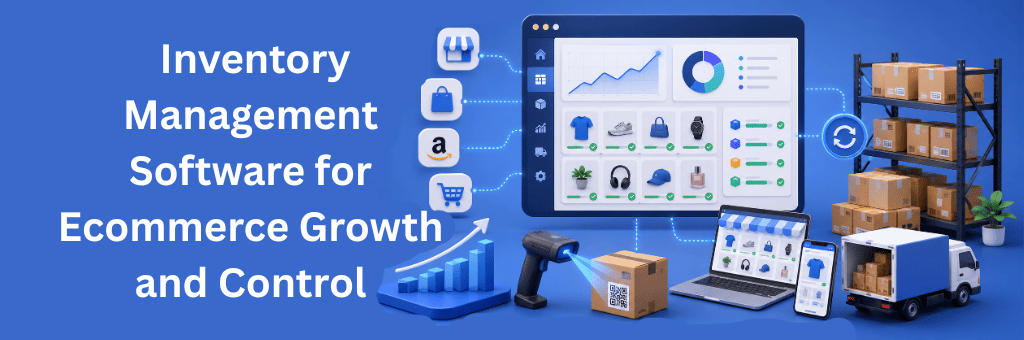
Online retailers manage products across stores, warehouses, and digital marketplaces.Consequently, reliable inventory control helps online retailers achieve steady and profitable growth. Inventory management software for ecommerce gives teams clear stock visibility. It also connects ecommerce inventory management software with sales and fulfillment workflows. Moreover, ecommerce inventory software reduces manual updates and costly data errors. Businesses can monitor quantities, orders, returns, and incoming stock easily. Effective stock control keeps popular items available during peak sales periods. As a result, retailers protect revenue and improve customer satisfaction. Modern systems support marketplaces, websites, physical stores, and warehouse operations. Consequently, growing brands can manage every sales channel from one platform.
Online businesses often sell products through several platforms. However, separate systems create incorrect stock quantities and delayed updates. A connected inventory platform solves these challenges through centralized information.
Inventory management software for ecommerce records every sale immediately. Therefore, teams always know which products remain available. The system also updates stock after returns, cancellations, and warehouse transfers.
Without reliable software, employees may update spreadsheets manually. Consequently, small mistakes can create overselling or unnecessary purchasing. Automated stock management removes this pressure from daily operations.
Additionally, unified data helps purchasing and fulfillment teams plan operations more effectively. Managers can identify fast-moving products and slower inventory. They can then adjust purchasing decisions before cash becomes trapped.
Modern retail inventory management also connects stores with ecommerce channels. Therefore, businesses can offer accurate availability across every customer touchpoint.
Stockouts can reduce revenue and damage customer trust. Meanwhile, overselling creates cancellations, refunds, and negative reviews. Reliable software reduces both risks through real-time updates.
Inventory management software for ecommerce deducts inventory after each confirmed order. It then shares the revised quantity across connected channels. Therefore, customers cannot purchase unavailable products easily.
The system can also reserve inventory during checkout. As a result, another shopper cannot buy the same final item. This feature becomes valuable during promotions and seasonal campaigns.
Additionally, automated alerts warn teams about low-stock products. Managers can create reorder points for every item. Consequently, purchasing teams can replenish products before shortages occur.
Some platforms also calculate safety stock requirements. They review sales speed, supplier lead times, and seasonal demand. Thus, teams can maintain balanced inventory without excessive purchasing.
Strong Ecommerce inventory software also detects unusual stock changes. Therefore, managers can investigate missing items or incorrect warehouse entries quickly.
The right solution should simplify operations without limiting future expansion. Therefore, businesses should compare functionality, integrations, usability, and reporting capabilities.
Important features include:
Effective ecommerce inventory management software should also support business rules. For example, teams may allocate specific quantities to certain marketplaces.
Additionally, the system should provide secure cloud access. Managers can then review operations from any approved device.
Scalable software should handle rising orders without slowing performance. Therefore, businesses can expand without replacing their core inventory platform.
Customers expect correct orders and timely delivery updates. However, disconnected systems can delay picking, packing, and shipping activities.
Inventory management software for ecommerce sends confirmed orders directly to fulfillment teams. Therefore, employees avoid repeated data entry. The system also identifies the correct warehouse for each order.
Smart routing can select the nearest fulfillment location. As a result, businesses reduce delivery time and shipping costs. This approach also supports efficient order fulfillment during high-volume periods.
Barcode scanning confirms every picked product. Consequently, teams reduce wrong-item shipments and missing quantities. Packing staff can also verify orders before dispatch.
Connected ecommerce order management displays every order status clearly. Teams can track payment, picking, packing, shipping, and delivery progress.
Moreover, inventory quantities update after each fulfillment action. Therefore, customer service teams receive accurate information. They can answer order questions without contacting warehouse employees.
Many sellers operate through Amazon, Daraz, Shopify, and other platforms. Yet each channel may use different product and order structures.
Marketplace inventory management software connects these channels through one central dashboard. It imports orders and shares updated stock quantities automatically.
For example, a customer may purchase an item through Daraz. The software deducts that quantity across Shopify and other marketplaces. Therefore, another customer cannot order unavailable stock elsewhere.
This synchronization supports reliable marketplace inventory management. Teams can also map product codes, variants, bundles, and warehouse locations.
Furthermore, centralized software simplifies multichannel selling. Employees can manage inventory without opening several marketplace accounts.
Businesses should check integration frequency before selecting software. Real-time synchronization provides stronger protection than scheduled updates. However, some marketplaces may restrict update speeds through their APIs.
Reliable multi-channel selling tools should also identify failed updates. Therefore, teams can correct listing or connection issues before sales suffer.
Manual stock counting consumes time and often creates errors. In contrast, automation keeps inventory records current throughout the day.
Ecommerce inventory management software records purchases, sales, transfers, returns, and adjustments. Therefore, teams receive an accurate inventory position.
The platform can also create suggested purchase orders. It considers reorder points, demand, and supplier delivery periods. Consequently, managers avoid unnecessary emergency orders.
Advanced systems may provide demand forecasting tools. These tools review historical sales and seasonal patterns. Thus, businesses can prepare for future demand more accurately.
Automation also improves supplier coordination. Purchasing teams can track expected deliveries and overdue shipments. Moreover, warehouse staff can plan receiving activities before stock arrives.
Businesses still need periodic physical stock counts. However, cycle counting tools make verification easier. Teams can count selected products without closing entire warehouse operations.
Business growth creates more products, orders, customers, and warehouse movements. Therefore, basic spreadsheets become difficult to manage.
Inventory management software for ecommerce creates a scalable foundation for expansion. It supports additional marketplaces, warehouses, stores, and user accounts.
Growing companies can also establish separate stock rules by location. For example, one warehouse may serve local deliveries. Another location may handle international orders.
Centralized ecommerce inventory software gives leaders one operational view. Consequently, they can compare channel performance and warehouse efficiency.
The platform also supports new product launches. Teams can prepare stock, listings, pricing, and fulfillment rules beforehand. Therefore, launches become more organized and less risky.
Additionally, detailed reporting helps businesses manage working capital. Managers can identify dead stock and excess purchasing. They can then run promotions or adjust future orders.
Scalable software turns inventory data into practical business decisions. As a result, companies can grow without losing operational control.
Modern retailers need more than stock tracking alone. Therefore, reporting tools have become an important part of inventory management software for ecommerce. They transform inventory data into practical business insights. As a result, managers can make faster and more confident decisions.
Detailed dashboards show stock movement, product performance, and warehouse activity. Moreover, businesses can monitor slow-moving products alongside best-selling items. Consequently, purchasing teams can reduce excess inventory while maintaining product availability. In addition, sales teams can identify high-demand products before seasonal peaks arrive.
Reporting also improves financial planning. For example, managers can compare inventory value, turnover rates, and replenishment costs across different locations. Therefore, businesses gain better control over working capital and purchasing budgets. Meanwhile, historical reports reveal buying trends that support future planning.
Real-time analytics also strengthen operational performance. Furthermore, warehouse managers can monitor fulfillment speed, stock accuracy, and inventory adjustments from one dashboard. As a result, they can resolve operational issues before they affect customers. Ultimately, ecommerce inventory software helps businesses improve efficiency while supporting long-term growth.

Ginkgo Retail connects inventory, orders, marketplaces, warehouses, and reporting tools. Therefore, retailers can manage daily operations through one unified platform.
Its inventory management software for ecommerce supports real-time product visibility. Teams can track stock across stores, warehouses, and sales channels.
The platform also strengthens marketplace inventory management software workflows. Businesses can connect online stores and major marketplaces through integrated processes.
Moreover, Ginkgo Retail helps automate replenishment, stock transfers, and order allocation. These capabilities reduce manual effort and improve inventory accuracy.
Integrated dashboards provide useful sales and stock insights. Therefore, decision-makers can identify shortages, excess stock, and product trends quickly.
Ginkgo Retail also supports growing retailers with configurable modules. Businesses can expand functionality as their operational requirements increase.
Effective inventory control affects sales, cash flow, fulfillment, and customer loyalty. Therefore, businesses need more than basic stock spreadsheets.
A suitable inventory management software for ecommerce solution creates one accurate stock source. It also connects purchasing, marketplaces, warehouses, and customer orders.
Retailers should prioritize real-time synchronization and useful reporting. They should also review integration quality and scalability.
Most importantly, software should match current processes and future expansion plans. Ginkgo Retail provides connected tools for inventory, orders, and marketplace operations. Consequently, online businesses can improve control while preparing for sustainable growth.
Choosing the right inventory management software for ecommerce helps businesses improve accuracy, efficiency, and customer satisfaction. Moreover, it connects inventory, orders, warehouses, and marketplaces through one centralized platform. As a result, retailers reduce manual work while maintaining real-time stock visibility across every sales channel.
Furthermore, scalable ecommerce inventory software supports business growth without adding operational complexity. It automates replenishment, improves fulfillment accuracy, and provides valuable reporting for better decision-making. Therefore, businesses can respond to changing customer demand with greater confidence. Ultimately, investing in reliable inventory management software for ecommerce creates a stronger foundation for sustainable growth, improved profitability, and long-term ecommerce success.
The best system provides real-time tracking, marketplace integrations, and automated replenishment. It should also support multiple warehouses and scalable order volumes.
Ginkgo Retail updates quantities across connected sales channels. It also provides low-stock visibility and supports replenishment planning.
Ginkgo Retail connects inventory, marketplaces, warehouses, and order workflows. Therefore, businesses can expand without managing isolated systems.
Ginkgo Retail supports centralized stock visibility, order processing, reporting, transfers, and channel integrations. Available features may depend on the selected implementation.
Ginkgo Retail can support connected ecommerce stores, marketplaces, warehouses, and retail locations. Integration availability depends on channel and business requirements.
Ginkgo Retail connects inventory data with order workflows. Therefore, teams can reduce manual entries and process accurate stock information.
Businesses should automate replenishment when product volumes and sales channels increase. Automation also helps when manual purchasing causes frequent shortages.
Synchronization updates quantities after every marketplace sale. Consequently, businesses reduce overselling, cancellations, and incorrect product availability.

CEO & Founder Ginkgo Retail & Comverse | Serial Entrepreneur | Award-Winning SaaS Innovator | E-commerce Veteran | Team Builder | Building AI-driven E-commerce Solutions. He has diverse experience of 10+ years in versatile domains of e-commerce, logistics and tech-oriented business. His eminent role in ecommerce management empowered him to benefit the industry with his knowledge, vision and experience.
Digital Wallet