
Best Ecommerce Inventory Management Software for Retail Growth
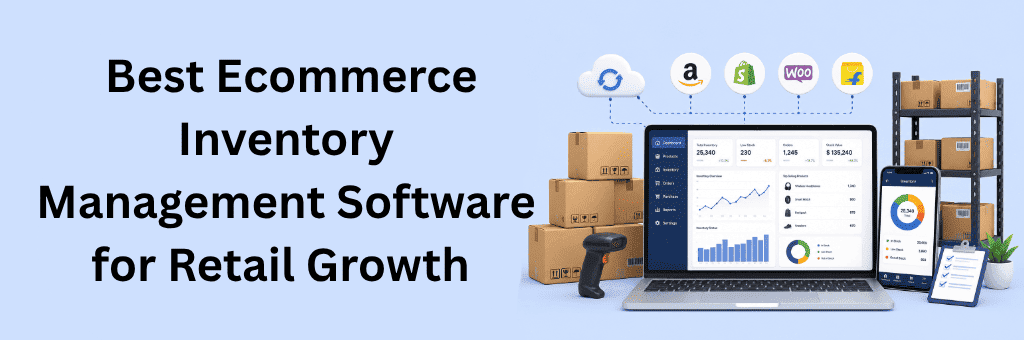
Choosing the Best ecommerce inventory management software is essential for businesses selling across websites, marketplaces, warehouses, and physical stores. As ecommerce operations grow, manual inventory updates become difficult to control. Therefore, retailers need one reliable system for tracking stock across every channel.
Modern inventory management software for ecommerce gives teams real-time inventory visibility. Moreover, ecommerce inventory management software connects products, orders, returns, warehouses, and purchasing activities. Businesses can therefore reduce stock errors while improving fulfillment speed.
Reliable ecommerce inventory software also helps retailers automate repetitive tasks. As a result, teams spend less time correcting stock records and more time supporting customers and business growth.
Why the Best Ecommerce Inventory Management Software Matters
Online retailers manage constantly changing inventory. Products move between warehouses, stores, websites, and marketplaces every day. Therefore, disconnected spreadsheets cannot provide dependable stock information.
The main Ecommerce inventory management software benefits include centralized visibility, automated updates, better forecasting, and reduced manual work. Moreover, the Best ecommerce inventory management software helps managers separate available, reserved, damaged, returned, and incoming inventory.
A reliable ecommerce stock management solution also provides real-time inventory visibility across sales channels. For example, shoppers can see more accurate product availability before placing an order. Consequently, businesses experience fewer cancellations caused by unavailable items.
Modern online inventory management software can also track every inventory movement automatically. Therefore, retailers gain stronger centralized stock management while maintaining accurate records across locations. A powerful multi-channel inventory management platform also makes it easier to control stock as the business expands.
Key benefits include:
- Real-time stock visibility
- Fewer manual inventory updates
- Better warehouse control
- Lower overselling risk
- Faster purchasing decisions
- Improved order accuracy
- Easier multi-channel expansion
- Better stock forecasting
As a result, growing businesses gain more control without increasing administrative workload. Choosing a dependable ecommerce inventory software solution can also support smoother operations, more accurate stock planning, and long-term online growth.
How the Best Ecommerce Inventory Management Software Prevents Stockouts
Ecommerce inventory software prevents stockouts by tracking stock levels continuously and identifying shortages before products become unavailable. The Best ecommerce inventory management software gives retailers a clearer view of available stock across warehouses, stores, websites, and marketplaces.
Without automation, inventory information can quickly become outdated. For example, an item may sell through Shopify while Amazon, Daraz, or another marketplace still displays the previous quantity. Consequently, another customer may order inventory that no longer exists.
Modern ecommerce stock management software solves this problem through automatic synchronization. Whenever an order, cancellation, return, adjustment, or transfer occurs, the system recalculates available inventory across connected channels.
In addition, businesses can define minimum stock levels and reorder points. Low-stock notifications then help purchasing teams act before inventory reaches critical levels. This makes an online inventory management solution especially useful for retailers handling fast-moving products.
Ecommerce inventory software stock automation can also support replenishment planning. The system may analyze:
- Current available inventory
- Reserved quantities
- Historical sales
- Sales velocity
- Supplier lead times
- Seasonal demand
- Incoming purchase orders
Therefore, businesses can maintain healthier stock levels while avoiding unnecessary overstock. A reliable multi-channel inventory management system also helps retailers respond faster to demand changes and reduce the risk of stock shortages.
Ecommerce Inventory Software Key Features for Better Accuracy
Businesses should evaluate functionality carefully before selecting inventory technology. An attractive dashboard alone does not guarantee reliable operations.
Important Ecommerce inventory software key features should include:
- Real-time inventory updates
- Multi-location inventory tracking
- Product and variant management
- Automated reorder levels
- Low-stock notifications
- Barcode scanning
- Purchase order management
- Supplier management
- Returns and cancellation handling
- Warehouse transfers
- Inventory valuation
- User access controls
- Integration with ecommerce channels
- Inventory reporting and analytics
Moreover, strong automated inventory tracking should record every stock movement. This allows managers to identify incorrect adjustments, missing products, or warehouse discrepancies quickly.
mproving Ecommerce Inventory Software Order Accuracy
Ecommerce inventory software order accuracy depends heavily on reliable stock information. When inventory data is accurate, the system can confirm whether an item is actually available before accepting or allocating an order.
Furthermore, location-level stock information can direct orders toward the most suitable warehouse. Therefore, warehouse teams can pick products faster.
Barcode verification can also reduce picking and packing mistakes. Employees scan products before shipment, while the system validates the SKU and quantity.
As a result, retailers reduce incorrect shipments, cancellations, refunds, and customer complaints.
Marketplace Inventory Management Software Benefits for Multi-Channel Selling
Selling through several marketplaces creates additional inventory complexity. Businesses may operate on Shopify, Amazon, Daraz, websites, stores, and other platforms simultaneously.
Therefore, marketplace inventory management software becomes important for maintaining one reliable inventory record.
The major Marketplace inventory management software benefits include centralized stock visibility and automated channel updates. Instead of changing inventory manually on every platform, businesses can manage stock from one system.
Marketplace Inventory Management Inventory Sync
Marketplace inventory management inventory sync keeps connected sales channels aligned with central inventory.
For example, when a customer purchases an item on Shopify, the central inventory quantity decreases. The updated quantity can then move automatically to Amazon, Daraz, or other connected marketplaces.
This multi-channel inventory sync reduces the risk of overselling. Moreover, inventory buffers can prevent businesses from exposing their complete physical stock to every channel.
A connected platform can also support:
- Marketplace order imports
- Product and SKU mapping
- Inventory buffers
- Channel-specific stock rules
- Location-based allocation
- Returns synchronization
- Order status updates
- Marketplace reporting
Consequently, sellers can expand across channels without creating separate inventory processes for each marketplace.
Ecommerce Inventory Software Business Growth Through Automation
Operational complexity increases as ecommerce businesses grow. More products create additional stock movements, transfers, returns, orders, and supplier activities.
Therefore, Ecommerce inventory software business growth becomes closely connected with automation and scalability.
Suitable inventory management software for ecommerce can support new warehouses, stores, marketplaces, products, and users without forcing teams to maintain separate systems.
Moreover, automation creates standardized processes. Employees can follow consistent workflows for receiving, picking, packing, transfers, adjustments, and replenishment.
Managers also gain better reporting. For example, they can identify:
- Fast-moving products
- Slow-moving inventory
- Low-stock products
- Overstocked items
- Warehouse discrepancies
- Product profitability
- Sales trends
- Inventory turnover
Consequently, decision-makers can react faster and use working capital more efficiently.
How Ginkgo Retail Supports Ecommerce Inventory Management

Ginkgo Retail provides a connected environment for retail and ecommerce inventory operations. The platform connects inventory, products, orders, warehouses, marketplaces, and sales channels within one operational ecosystem.
Therefore, businesses can maintain a centralized inventory view instead of managing disconnected stock records.
Ginkgo Retail also supports multi-channel inventory sync. Inventory changes can move across connected platforms while reducing repeated manual updates.
Moreover, teams can monitor available, reserved, returned, damaged, and location-level inventory. This visibility supports better purchasing and warehouse decisions.
Connected workflows can also improve order allocation, warehouse picking, packing, and fulfillment. Consequently, businesses gain stronger operational control as transaction volumes increase.
Choosing the Best Multi-Channel Inventory Management Software
The Best multi-channel inventory management software should support more than basic stock counting. It should connect sales channels, inventory locations, warehouses, orders, purchasing, returns, and fulfillment.
Before selecting a platform, businesses should evaluate:
- Real-time synchronization
- Marketplace integrations
- Warehouse management capabilities
- Inventory automation
- Reporting and analytics
- Replenishment functionality
- Order management integration
- Multi-location support
- Scalability
- User permissions
- API and integration flexibility
Moreover, businesses should consider future requirements rather than only current transaction volumes. A limited platform may work today but create operational problems after expansion.
Therefore, retailers should select software that can grow alongside their channels, warehouses, product catalog, and customer demand.
Final Perspective on the Best Ecommerce Inventory Management Software
The Best ecommerce inventory management software should give retailers accurate inventory visibility while reducing repetitive manual work. It should connect inventory with ecommerce channels, marketplaces, warehouses, purchasing, and order fulfillment.
Furthermore, strong inventory automation helps businesses prevent stockouts and overselling. Reliable synchronization also improves order accuracy and customer satisfaction.
The right ecommerce inventory management software can therefore support both daily operations and long-term expansion.
Ginkgo Retail brings inventory, orders, warehouses, products, and multiple sales channels into one connected environment. As a result, retailers can improve stock control while preparing their operations for future growth.
FAQs:
- What is ecommerce inventory management software?
Ecommerce inventory management software tracks products, stock levels, sales, returns, purchases, transfers, and warehouse movements across ecommerce operations.
- How does ecommerce inventory software reduce stockouts?
It monitors available inventory, sends low-stock notifications, supports reorder points, and automatically updates inventory after transactions.
- What are the main ecommerce inventory management software benefits?
The main benefits include better inventory accuracy, reduced manual work, faster stock updates, improved fulfillment, and stronger multi-channel visibility.
- Why do multi-channel retailers need inventory synchronization?
Synchronization updates inventory across connected marketplaces after sales, returns, transfers, or adjustments. Therefore, businesses can reduce overselling.
- What features should ecommerce inventory software include?
Important features include real-time stock tracking, reorder automation, warehouse management, barcode scanning, reporting, marketplace integrations, and multi-location support.
- Can marketplace inventory software prevent overselling?
Yes. It can synchronize available inventory across channels and apply stock buffers to reduce the chance of selling unavailable products.
- How does inventory software improve order accuracy?
The software validates available stock, supports warehouse allocation, and can use barcode verification during picking and packing.
- How does inventory software support business growth?
It allows businesses to add products, warehouses, marketplaces, locations, users, and higher order volumes without relying on additional manual processes.
Written by

Obaid Arshad
CEO & Founder Ginkgo Retail & Comverse | Serial Entrepreneur | Award-Winning SaaS Innovator | E-commerce Veteran | Team Builder | Building AI-driven E-commerce Solutions. He has diverse experience of 10+ years in versatile domains of e-commerce, logistics and tech-oriented business. His eminent role in ecommerce management empowered him to benefit the industry with his knowledge, vision and experience.
Digital Wallet